
My longing is told to the wind;
Is it a thing in which one may joy,
That in this land we abide?
Fair beckons the strand of Keitahi,1
And the wave-beat of Tausisivatvaki1—
Who is there content to stay here?
Let it be like the isies of Haapai,
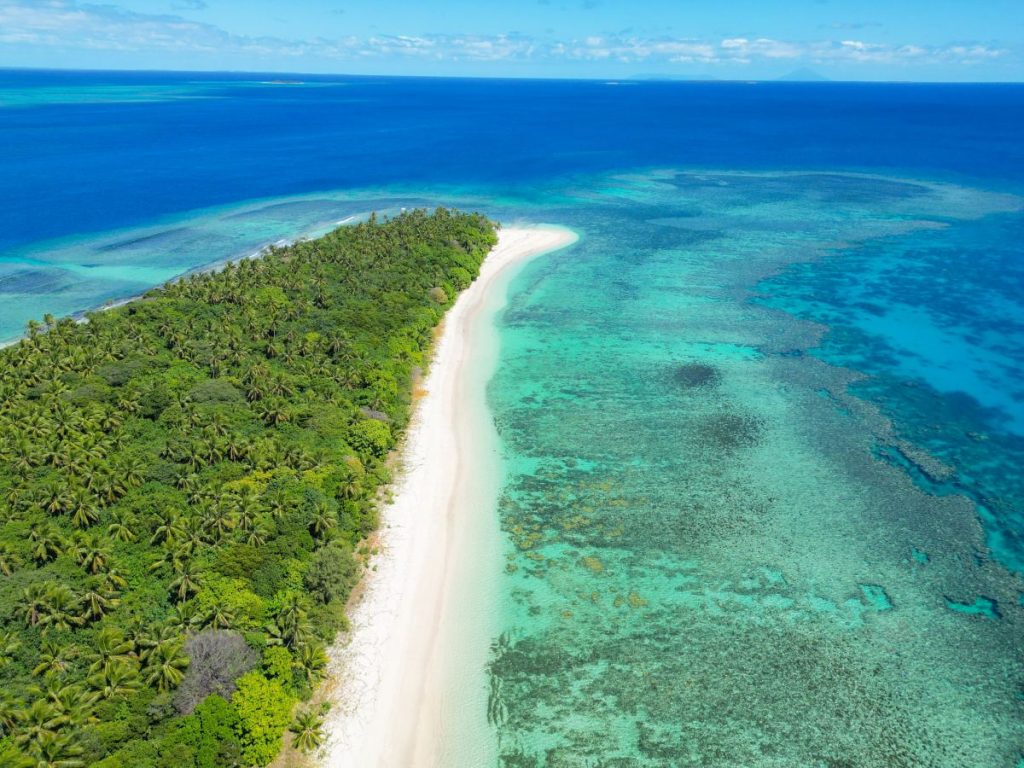 |
| Ha'apai, Tonga Photo credit: Tonga Pocket Guide |
In the storm-wind one hidden from other,
But in calm they appear to each other.
Let us see their dear elasping of hands,
Like the joy friends take in each other.
I long for Lofia2 in Vailahi,
Its crest was stooped o'er by the fire smoke;
Let us go and sleep on the summit.
Put in at Paluki3 at Kasivaki,
Sleep with Loupua4 at Pangai.
At dawn go early together
The women, when flowers are opening,
Pluck siale when blossoms are drooping,
Plait it, and to the sea we go garlanded,
And see the ship of the white men5,
And the harbor of sailing canoes.
When the wind blows direct from Toku6
From the chief's compound you straight-way shall harken
To the waves in the midst of the strand,
Fakanamuli7 where people are gathered.
I shall stand in Alaimuitoa
Where there comes the fragrance of pua
From the water in Velitoa8.
Like a cloth9 that is laid outspreading
Are the mangroves of Tongoleleka10.
When the sun is near to its setting
Beams glance on the palms of Lifuka;
When the south wind blows full swelling
Look aside at the mount of Tofua11
And Tohonakao12 that is peopled.
Falepapalangi (19th century) Tonga
Translated by E. E. V. Collocott
Tales and Poems of Tonga, E. E. V. Collocott, Bernice P. Bishop Museum, Bulletin 46, Honolulu, 1928 [Kruas Reprint Co., 1971]
Notes (taken from E.E.V. Collcutt op cit):
- Keitahi and Tausisivavaki are beaches in Vavau.
- Lofia is the volcano in Tofua, Haapai. Vailahi (Great water) would seem to be the crater lake of this volcano. That the volcanic cone is in the lake is a peculiar construction. Their being in close association must be understood without pressing the local significance of ‘i. It is said, however, that Lofia is the name of the god who lies within the crater and spurts out fire and smoke and stones.
- Paluki is a beach, affording excellent anchorage for small boats, in Lifuka, Haapai. Kasivaki is unidentified, but is evidently a place in the same locality.
- Loupua (Leaf of pua, a plant with sweet~smelling blooms) is a nickname for the king, possibly the King of Haapai. The people of Haapai generally are said to be sometimes called pita. Haapai is a cluster of islets, scattered so that its people spend more time at sea than do those of any other part of Tonga. This exposure to wind and weather is said to give them a ruddy complexion, whence the nickname pita, for the red blooms of the plant. Pangai is on the island of Liinka, Haapai.
- When vessels visit Haapai they put in at Lifuka, but it is possible that the remains of the Port-au.-Prince, in which Mariner arrived in 1806 are indicated. The Port-au.-Prince was cut out on the sea-front of Lifuka. She was burned, but her final resting place was in shallow water and doubtless a little wreckage was visible.
- A number of localities bear the name Toku. If the island off Vavau is indicated, the wind would be from the north.
- Fakanumuli is a tract near the sea front oi Lifuka. Alaimuitoa lies to the west of Fakanamuli.
- Velitoa is possibly the pool in which Finau bathed just before the assassination of Tupou Niua (Mariner, vol. 1, p. 129 - bibliographic reference below).
- The meaning of kumi, translated cloth, is really a measure of cloth.
- Tongoleleka (Short mangrove) has become the proper name of a locality in Lifuka, occupied by a large village.
- Tofua, the lofty volcanic island, and its still loftier neighbor Kao, are about 35 miles to the westward from Lifuka. The shore of Lifuka, about which the latter part of this poem centers gives a fine view of these two mountain islands. The setting sun throws about them wonderful and ever-changing beauties.
- Tohonakao is the summit of Kao. It is not clear what is meant by “Tohonakao that is peopled.” Tofua was inhabited until quite reeent times, the people removing because the volcano erupted. People still have their gardens there, and visit them from neighboring islands. But there seems no record of Kao being peopled to its summit.
Mariner, William; Martin, John (editor). An Account of the Natives of the Tonga Islands, in the South Pacific Ocean. With an Original Grammar and Vocabulary of Their Language. Compiled and Arranged from the Extensive Communications of Mr. William Mariner, Several Years Resident in Those Islands, John Murray, 1817

No comments:
Post a Comment
Please keep your comments relevant and free from abusive language. Thank you. Note that comments are moderated so it may be a day or two before your comment is posted - irrelevant or abusive comments will not be published.